How to Fit a Dining Table in a Small Living Room: The Ultimate Guide

Living in a compact apartment or a cozy cottage often comes with a common design dilemma: the lack of a formal dining room.
When your living area has to serve as a lounge, a home office, and a media center, finding space for a mealtime hub can feel like solving a high-stakes puzzle.
However, a dedicated spot to eat—whether it’s for a quick breakfast, a romantic dinner, or a workspace—is essential for making a house feel like a home.
If you are wondering how to fit a dining table in a small living room, you are in the right place.
With a blend of strategic furniture selection, clever layout planning, and a few visual tricks, you can create a functional dining area without making your living room feel cramped or cluttered.
In this comprehensive guide, we will explore everything from table shapes and multi-functional furniture to the psychological tricks of interior design that make small spaces feel vast.
Start with a Reality Check: Measure and Map
Before you browse furniture catalogs, you must understand the physical constraints of your room.
The most common mistake in small-space design is “eyeballing” the dimensions.
The 36-Inch Rule
To ensure your living room remains walkable, you need to account for more than just the table’s footprint.
You need to account for the “clearance zone.” Ideally, you should leave about 36 inches between the edge of the table and the nearest wall or piece of furniture.
This allows enough room for someone to pull out a chair and sit down comfortably without blocking the flow of traffic.
In ultra-tight spaces, you can squeeze this down to 24 inches, but anything less will make the room feel claustrophobic.
Identify “Dead Zones”
Look for underutilized areas in your living room. Is there a corner that currently holds a dusty floor lamp?
Is there space behind your sofa? Or perhaps a window nook that is currently empty? These “dead zones” are the primary candidates for your new dining area.
Choosing the Right Shape: Round vs. Rectangular
The shape of your table is perhaps the most critical factor in determining how to fit a dining table in a small living room.
The Power of the Round Table
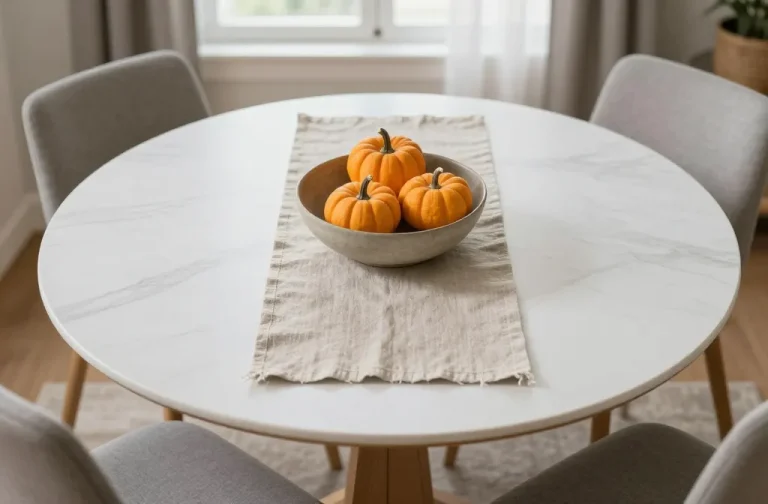
Round tables are the champions of small spaces. Because they lack sharp corners, they take up less visual weight and allow for better “flow” in a room.
You are less likely to bump into a rounded edge when walking past.
Furthermore, pedestal-style round tables are even better because they eliminate the four legs at the corners, providing more legroom and allowing you to tuck chairs in further.
The Versatility of the Rectangular Table
While round tables are great for flow, rectangular or square tables are better for “anchoring” against a wall.
If you have a long, narrow living room, pushing a rectangular table flush against a wall or placing it behind a sofa can save a significant amount of floor space.
When you have guests, you can simply pull it out into the center of the room.
Strategic Placement: Where Does it Go?
Placement is where the magic happens. Here are four proven layouts for integrating a dining area into a living room.
Behind the Sofa
One of the most popular ways to solve the “how to fit a dining table in a small living room” puzzle is to place a long, narrow console-height table directly behind your sofa.
This creates a “zoned” feel, separating the lounging area from the eating area without the need for walls. You can use stools that tuck completely under the table when not in use.
The Corner Banquette
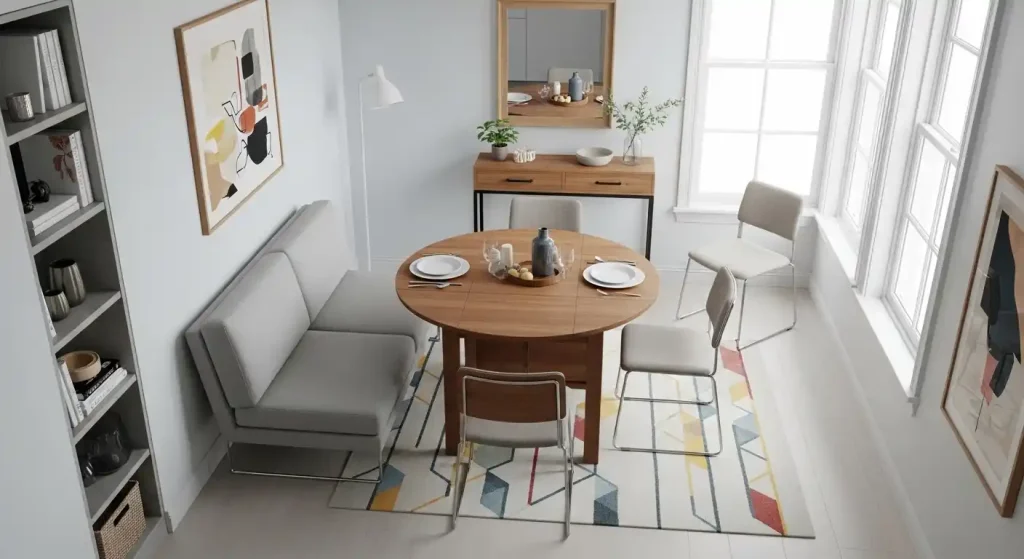
If you have an empty corner, consider a banquette or an L-shaped bench.
Benches are incredibly space-efficient because they can be pushed right against the wall, eliminating the need for the 36-inch clearance zone behind chairs.
This creates a cozy, cafe-like vibe that feels intentional rather than cramped.
The Window Nook
Placing a small bistro table in front of a window utilizes space that is often left empty.
It also provides natural light and a view while you eat, which can make a small dining area feel much larger and more pleasant.
The “Floating” Zone
In an open-concept studio, you can use the dining table as a divider.
Placing a table between the “kitchen” side and the “living” side of the room helps define the functions of each space.
Invest in Space-Saving Table Designs
When every square inch counts, your furniture needs to work harder. Look for these specific types of tables designed for small-scale living:
- Drop-Leaf Tables: These are the ultimate chameleons. With the “leaves” down, the table can act as a slim console or side table. When it’s time to eat, flip the leaves up to create a full dining surface.
- Wall-Mounted Tables: If floor space is non-existent, a wall-mounted “floating” table that folds down when not in use is a lifesaver.
- Extendable Tables: Look for tables with hidden “butterflies” or leaves. You can keep the table small for daily use and expand it only when you have company.
- Gateleg Tables: Similar to drop-leaf, these have legs that swing out to support the leaves, offering incredible stability while folding down to just a few inches wide.
The Seating Secret: Benches and Ghost Chairs
The table is only half the battle; the chairs often take up more room than the table itself.
Use Benches
As mentioned with the banquette, benches are a small-space hack.
A backless bench can be tucked completely under the table when you aren’t eating, keeping the floor area clear and the sightlines open.
The “Ghost” Effect
Visual clutter is the enemy of a small room. Using “Ghost chairs” (transparent acrylic chairs) is a brilliant designer trick.
Because you can see right through them, they occupy zero “visual space,” making the room feel airy and light even if it’s packed with furniture.
Stackable or Folding Chairs
If you only need seating for four occasionally, keep two comfortable chairs at the table and store two high-quality folding or stackable chairs in a closet or even hung on a wall as “art” until they are needed.
Visual Tricks to Expand the Space
Learning how to fit a dining table in a small living room is as much about psychology as it is about geometry.
Use Mirrors
Placing a large mirror on the wall adjacent to your dining table can double the perceived size of the space.
It reflects light and creates the illusion of depth, making the dining “nook” feel like a grand dining room.
Choose Leggy Furniture
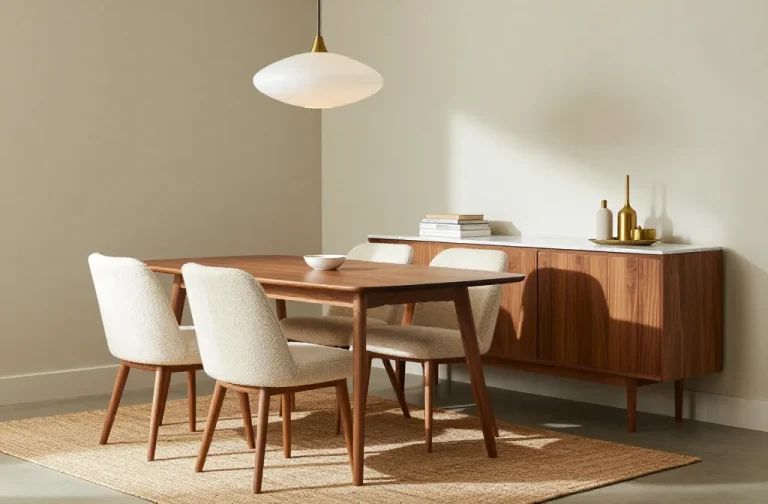
Furniture that sits high on slim legs (Mid-Century Modern style) allows you to see more of the floor.
The more floor you can see, the larger the room feels. Avoid “skirted” furniture or heavy, blocky bases that block the view of the floor.
Go for Glass
A glass-top table has the same effect as a ghost chair. It provides a functional surface without creating a visual “block” in the middle of the room.
Zoning with Rugs and Lighting
To make a dining table feel like it belongs in a living room rather than just being “tossed in,” you need to create a zone.
The Power of a Rug
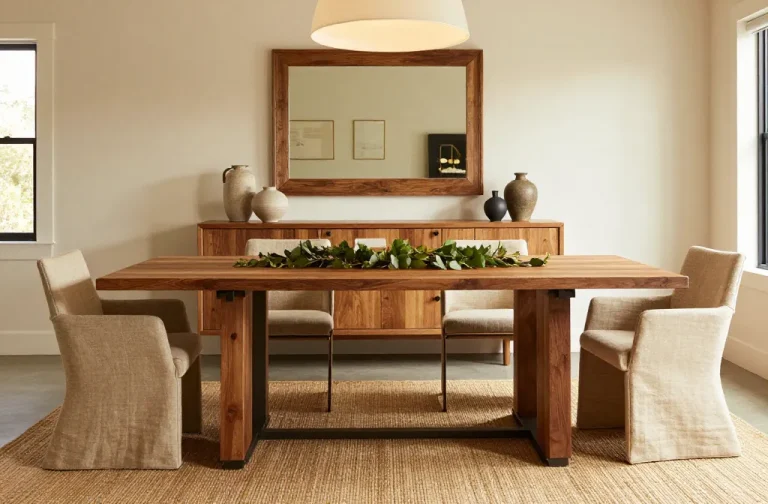
Placing a rug under the dining table helps define the area as a separate “room” within a room.
Ensure the rug is large enough that the chairs stay on the rug even when pulled out.
Statement Lighting
A pendant light or a chandelier hung directly over the dining table acts as an anchor. It draws the eye upward and signals that this specific spot has a dedicated purpose.
If you can’t hardwire a light, a plug-in swags lamp or a tall arched floor lamp can achieve the same effect.
Multi-Functionality: The Modern Necessity
In a small home, a dining table is rarely just a dining table. When planning your layout, think about how the table can serve other purposes.
- The Home Office: If you work from home, choose a table that is at a comfortable height for typing and has easy access to power outlets.
- The Kitchen Island: If your living room is adjacent to a tiny kitchen, a counter-height table can serve as extra prep space during the day and a dining spot at night.
- The Entryway Console: A slim drop-leaf table in the living room can double as an entryway “landing strip” for keys and mail.
Conclusion
Learning how to fit a dining table in a small living room doesn’t mean you have to sacrifice style or comfort. It’s about being intentional with your choices.
By prioritizing “leggy” furniture, utilizing corners, and choosing shapes that promote movement, you can create a beautiful space to share meals and memories.
Remember, the goal isn’t to fit the biggest table possible; it’s to create a balanced environment where you can relax, eat, and move freely.
Measure twice, shop once, and don’t be afraid to think outside the box—or the dining room!
Whether it’s a tiny bistro set by the window or a clever console behind the sofa, your perfect dining spot is waiting to be discovered.